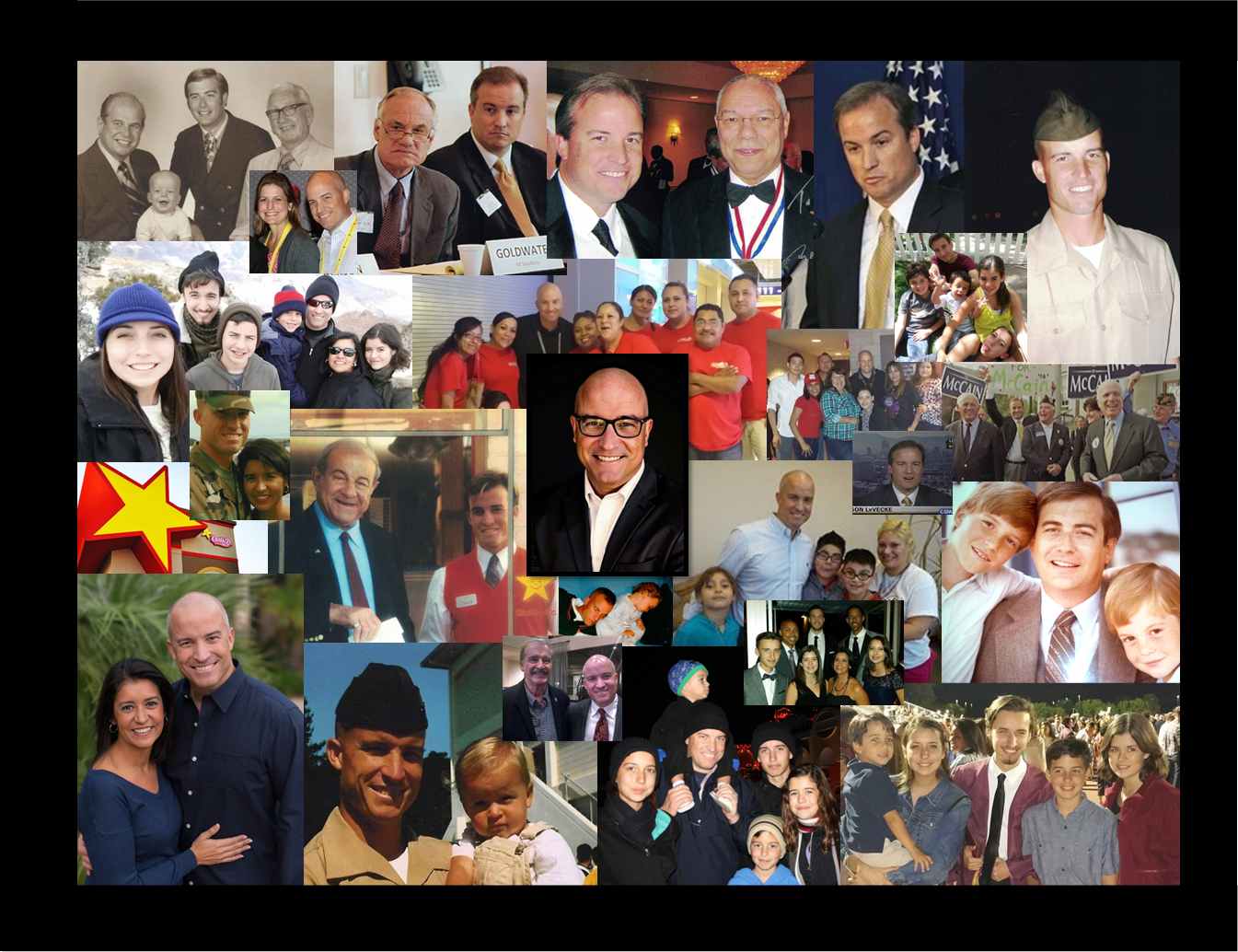
The short version is on the home page. This is the long one, in order, including the parts that didn’t go so well.
1971–1986
Entrepreneurs and family businesses on both sides
My maternal grandparents were Carl and Margaret Karcher, who founded Carl’s Jr. My father’s family founded LeVecke Corporation. Unfortunately, my father died of a heart attack at thirty-eight. I was ten and the oldest of seven.
1986
First job, Carl’s Jr. #512
Cashier and cook, at the store in front of CKE’s corporate headquarters in Anaheim. I wanted to learn the business from the counter, so I later went and worked elsewhere for a few years — coaching high school baseball at Mater Dei, waiting tables at Ruby’s Diner in Fullerton — before coming back to it.
1990–1997
Store manager
Back at Carl’s Jr. through college, then promoted through several restaurants in Orange County and San Diego. I met my wife, Andi, while managing store #13 in Anaheim.
1997–2002
United States Marine Corps
I enlisted at twenty-six, with a wife and a newborn, both my grandfathers and my father had served and I wasn’t getting younger. Active duty, cryptologic Arabic linguist supporting signals intelligence. Defense Language Institute at the Presidio of Monterey, then Goodfellow Air Force Base, then 2d Radio Battalion at Camp Lejeune.
I was still active duty but on leave in California, sitting in franchise training, on September 11, 2001. Stop lossed for a period but was ultimately honorably discharged E-5 May of 2002.
2001–2008
Building the franchise organization
My mother Margaret and brother Carl wanted to franchise Carl’s Jr. restaurants in Arizona. I was negotiating terms from a training exercise in Norway and doing the paperwork from North Carolina. We started with two stores.
We grew it fast, buying out local franchisees and building ground-up. Our sisters, Margaret, Mary Beth, Marissa, and people we’d worked with in California moved to Arizona to help run it. By 2008 we added sixty Hardee’s across southern Illinois and western Kentucky. At its peak the organization ran more than 200 restaurants in seven states, over $150 million in revenue, and 4,000 employees. My peers elected me president of the Carl’s Jr. Franchisee Association from 2008 to 2010.
2008
McCain
I worked on Senator McCain’s presidential campaign finance committee, alongside my sister Margaret and my brother Carl. For me it lasted a short time. Once it became clear how central immigration was going to be in that race, and how far I intended to go on it, the arrangement ended. I understood why. I didn’t change my position.
He had been generous to me and he mattered a great deal to me. He was and is one of the greats and would have made a great president.
2007–2008
Running the fleet on fryer oil
I read a newspaper article and assumed it had to be hippies in a backyard filtering oil through a sock. I told our fleet manager to convert one vehicle and see. It worked. We built a small vegetable-oil filling station at the office, and by 2008 about twenty percent of the fleet was running on waste oil filtered from our own restaurants, with the rest scheduled by 2010. It saved money against a fuel bill of roughly a hundred thousand dollars a year.
We argued it the same way we argued everything else: good for the environment, good for national security, good for the economy, and it made business sense, so we did it. I also said the slow integration of ethanol into fuel blends looked like politicians protecting their own special interests, which did not make me popular either. Arizona PBS and MSNBC both covered it. The trucks smelled like french fries.
2007–2010
Arizona
Arizona passed an employer sanctions law under which a single unauthorized worker could cost a company its license. We had about eleven hundred employees in the state. I opposed it publicly, lobbied for the federal comprehensive immigration reform bill, debated State Senator Russell Pearce on C-SPAN, and opposed SB 1070 when it followed. I led Arizona Employers for Immigration Reform, a business association of more than a hundred corporate members, and with Mac Magruder, who ran the state’s McDonald’s franchises, organized Wake Up Arizona to put the Stop Illegal Hiring initiative on the 2008 ballot. It failed. In the same cycle I was the principal underwriter of Proposition 105, a tax-limitation measure.
We also did something we didn’t discuss publicly for eight years. Julie Pace recruited us to quietly fund the racial profiling case against Sheriff Joe Arpaio, which became Melendres v. Arpaio. We paid the legal bills anonymously, first through Pace and then through David Bodney at Steptoe after Pace’s firm declined to take the sheriff on. We also funded the Respect-Respeto hotline, which gave immigrants somewhere to call for help. It also helped identify plaintiffs for the case. We stayed anonymous because we believed the sheriff retaliated against people who crossed him.
By 2010 the case had cost us roughly four hundred thousand dollars and our business was losing customers as families left the state. We couldn’t carry it any further and we had to pull back. Bodney withdrew. Covington & Burling picked it up pro bono, the ACLU and MALDEF carried it forward, and in 2013 a federal judge found that the sheriff’s office had engaged in racial profiling. We were never reimbursed. We’d spend it again.
The law and the consequences were costly. We had twenty to forty more restaurants in the Arizona pipeline and went back and forth on them week to week — proceeding, pausing, proceeding again — before putting most on hold and diversifying out of the state.
2013–2015
The audit, and the exit
On June 25, 2013, ICE served a company-wide Notice of Inspection covering three years of records and more than ten thousand employees across roughly a hundred restaurants. We used E-Verify. We required I-9s to verify Social Security numbers. Employees signed immigration compliance acknowledgments. We trained the people who completed the I-9s, and we had hired two national law firms to audit every form. We went past what the law required, and we still had no way to know.
In November 2014 ICE returned Notices of Suspect Documents and Discrepancies naming more than twelve hundred people. About five hundred were active employees, spread across a hundred locations. They went. We flew eighty managers and trainers into Arizona for up to three months to process the separations and to recruit, hire and retrain — over the holidays, and directly into the Super Bowl in Phoenix. Our filings in the bankruptcy put the total cost at roughly ten million dollars.
It may have been the primary cause but to be fair, not the only cause. The fuller account is here.
2016
United States v. Texas
Eight months after the Chapter 11 filing, with the case still open, I signed on as one of sixty-three amici curiae — employers and business leaders — to a brief before the Supreme Court arguing that our immigration enforcement policies harm American businesses. I had been making that argument for nine years by then, and it had already cost me the company.
2016–2018
Consulting
Project work in Arizona and California — infrastructure rollouts, RFP management, lease and contract negotiation, real estate, franchising, distribution. Starting over at forty-five with my wife, Andi and our five children.
2018–2025
Chief Commercial Officer, LeVecke Beverage Group
My uncle Neil recruited me to build a sales division at the family’s spirits business, a large independent producer and bottler. I ended up running the entire commercial organization as a hired executive, reporting to the CEO, President, and ownership: about $200 million across owned brands, private label control brands, and contract production. While part of the family, I held no ownership stake or capital authority. My remit was commercial — pricing, margin, trade spend, freight, and the people who sold.
Revenue grew significantly, through the expansion of brands and opening export markets across Asia Pacific, Latin America, the Caribbean, Africa, and the Middle East. Unfortunately COVID hit in the middle of a large capital expansion for the family business, which was in and of itself its own education.
2026–
Lincoln, Berry & Co.
My own firm. Sales and market development for brand owners and suppliers who need a commercial organization without building one.